Money between people
A loan is not a spending category.
How a loan is kept
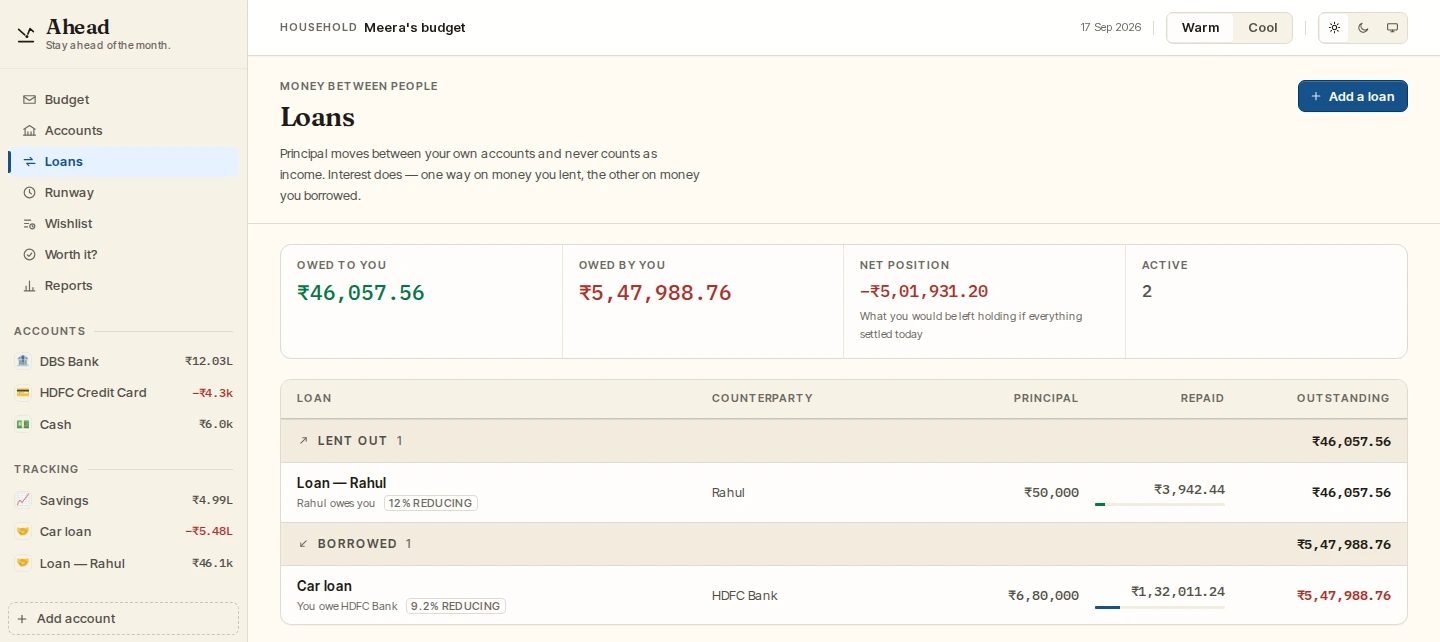
Principal and interest are kept apart, because the budget treats them differently.
Getting this wrong in the obvious way, by routing all of it through income, makes every repayment look like a payday. Then your reports congratulate you for being paid back money that was always yours.
The number nobody quotes
11% flat is not 11%.
A flat rate charges interest on the original amount for the whole term, including the part you have already paid back. A reducing rate charges only on what is still owed. The same quoted percentage costs close to twice as much when it is flat.
Ahead works out the real rate from the instalment you were quoted and shows it on the loan, before it draws the schedule.
One loan, read end to end
Every figure traces back to a row.
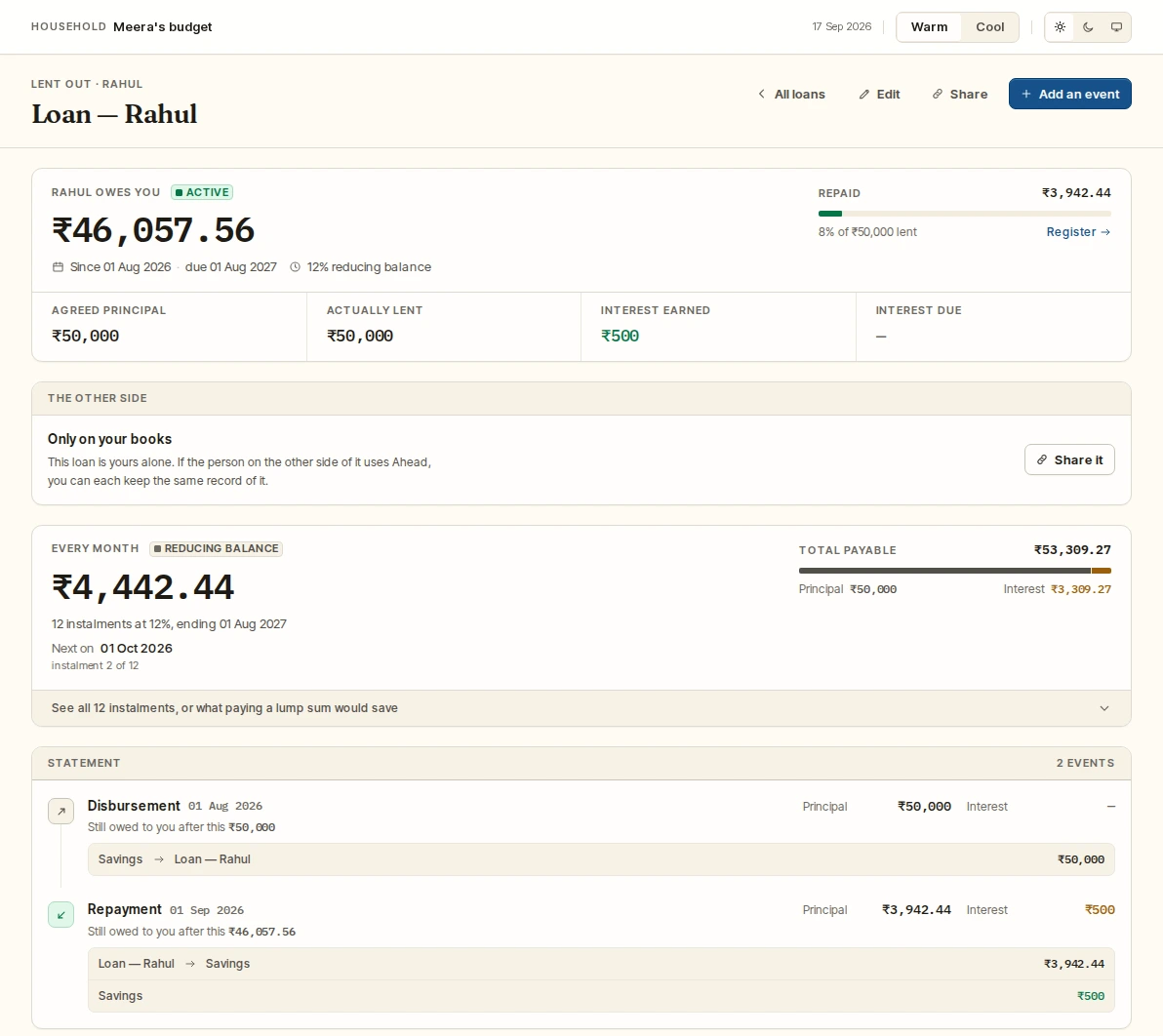
A loan’s page reads like a statement: what is still owed, how much has been repaid, then one entry per event. Each event opens to show the transactions it wrote, and each of those opens the account it sits in, so a figure you doubt can be followed down to the transaction that made it.
There is no delete. A correction is an adjustment or a write-off, and both leave a record.
The other person
One agreement, two sets of books, neither one in charge.
If your brother uses Ahead too, link the loan and both households keep their own record of it, in step. A repayment he enters arrives with you as a claim and moves nothing until you confirm it. Sharing is off by default, chosen loan by loan, and either of you can stop without anything disappearing from the other side.
If he does not, send him the statement instead: a read-only link to that one loan, with a password and an expiry if you want them. He needs no account to open it.
Your books
₹40,000
You logged three repayments.
Their books
₹35,000
They logged four.
₹5,000 apart. Ahead shows both figures and names the difference. It does not decide which of you is right — one of you has a repayment to record, and only the two of you know which.
Find out what your EMI is really costing you.
Record the terms once and the schedule, the outstanding balance and the effective rate follow.
- No card
- Nothing starts charging when the trial ends.
- Nothing to connect
- No bank login, and nothing reads your SMS.
- Export whenever
- A zip of CSVs, paid or not.