Envelope budgeting · One set of books
Stay ahead
of the month.
Envelope budgeting for an Indian household. Every rupee that arrives is spoken for before it is spent, on one set of books that two people keep together.
60 days free · No card · Then ₹199 a month, per household
The month that has not happened yet
Knowing what August cost does not change September.
What a tracker set aside for it
What the envelope held
₹0
₹18,000
It categorised the bill correctly, on the day it arrived.
₹1,500 every month for a year, for a premium that was always coming.
Most money apps read your statements and sort them into categories. That was a hard problem fifteen years ago and it is a solved one now. It is also a rear-view mirror: it tells you what happened, accurately, once it has already happened.
The months that hurt are rarely the ones with too much dining out. They are the ones where a hospital bill arrives, the school fees fall due, or the insurance premium lands. None of those are monthly, and every one of them is certain. The only thing in doubt is which month.
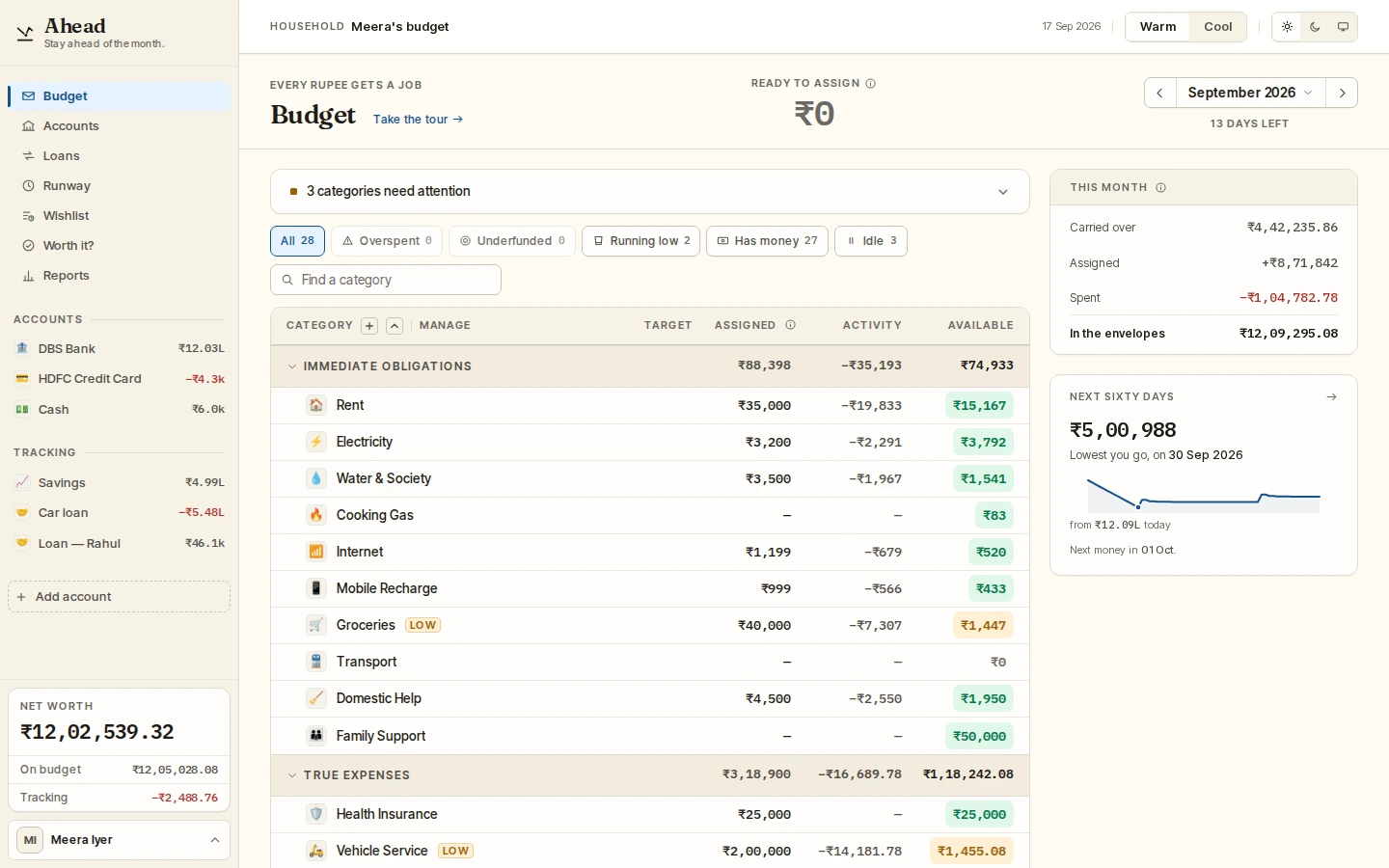
So Ahead budgets for them before they arrive. A category holds a little every month and keeps it, which is what turns an ₹18,000 bill from a month collapsing into an envelope opening.
The app calls these True Expenses and seeds them on day one: health insurance, medical, vehicle service, home repairs, the festival fund. Not monthly, not optional, and not a surprise unless nobody was counting.
The runway timeline
If you spend what you have budgeted, your lowest point is
−₹23,500
On 31 October · a Saturday
That is not a question about your balance. You hold ₹46,300 today and the salary lands on the 1st. It is a question about order: the rent, the EMI and a ₹48,000 insurance premium all leave before the next one does. There is a day coming where things get tight, and it is being said while there is still time to move something.
−₹23,500
on 31 October, the day before the salary lands
A balance tells you what you have. This tells you the day you have least of it — which is the day something bounces.
It never invents income. No salary averaged out of history and drawn as though it were known.
If nothing is coming in before the horizon, it says so instead of screaming about a crisis that is not going to happen.
No advice. It shows you the day; what to move is yours to decide.
What a category holds
Every rupee gets a name.
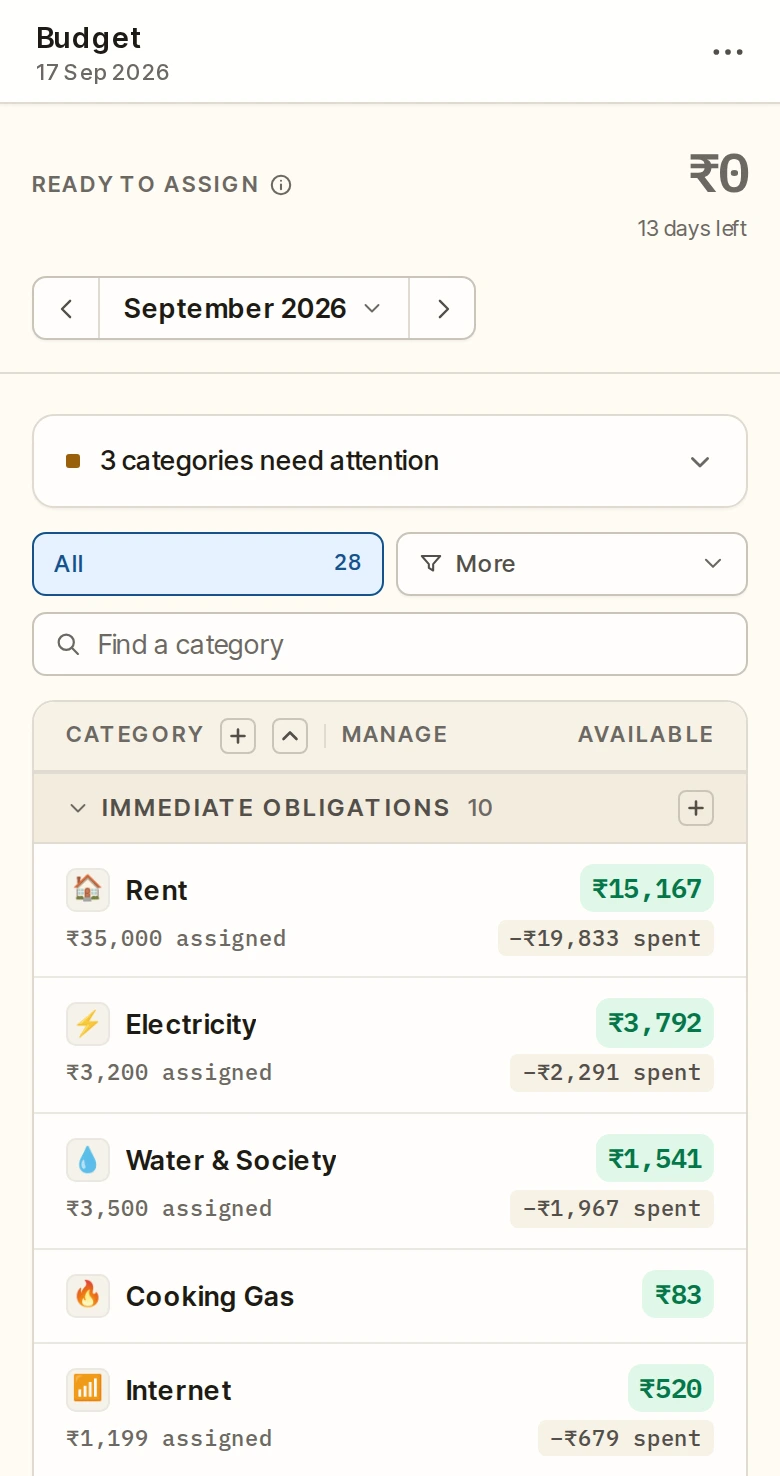
Zero-based and in rupees: income arrives, you divide it until nothing is unassigned. Unspent money survives the month, which is the entire point of an envelope. Goals accumulate inside them: a festival fund is a category with a target, not a separate product.
of ₹75,000 by 18 October
₹13,500 a month to stay on target
- Meeraowner
- Nikhilpartner
- Lakshmiviewer
A partner budgets exactly as the owner does and touches none of the billing. A viewer sees everything and changes nothing.
Loans between people
Money lent to your brother is a loan, not a memory.
Record the terms once and Ahead keeps the schedule, the outstanding balance and every repayment on both sides. If the other person also uses Ahead, one agreement stays in step across two sets of books, with sharing off by default and optional forever.
Meera’s books
Lent to Rahul
₹29,893
outstanding · 5 of 12 repaid
Repayments go back to Savings
Rahul’s books
Borrowed from Meera
₹29,893
outstanding · 5 of 12 repaid
₹4,442 a month
The fifth repayment was recorded by Rahul. It moved nothing in Meera’s books until it was confirmed there, and neither side can write the other’s ledger.
What Ahead does not do.
Listed here, on the page where it would be easiest to leave out. Some of these are choices and some are simply not built yet; the difference is stated either way.
Nothing reads your bank account, your UPI messages or your SMS. Transactions are entered by hand, and Ahead never holds a bank login, so there is none to steal.
No portfolio tracking, no credit score, no insurance quotes. Ahead is a budget, and it stays one.
No grade out of ten, no streaks, no congratulating you on a tight month. Reports state what they left out.
CSV with column mapping and a dedupe key, undoable as a batch. Not in the product today.
Ahead is a web app. It runs in the browser on a phone or a computer; there is no App Store or Play Store listing.
One price, per household.
Not per person. A budget two people cannot both open is not a household budget, so the second seat is not a line item. Up to four people share one price, which is a household rather than a company.
Everything on the pricing page- Trial
- 60 days, no card
- Monthly
- ₹199
- Yearly
- ₹1,499
- Lifetime
- ₹4,999, paid once
- People included
- Up to four, at one price
- If you stop paying
- Read-only. Nothing deleted.
- Export
- Always works
Questions
All of themNo, and that is deliberate. Ahead never asks for your bank login, nothing reads your account for it, and it does not read your UPI messages or SMS. You enter what you spend, which is also the part that makes a budget work: the app is not something that happens to you.
Yes. Cash is an account like any other: top it up when you withdraw, spend from it at the vegetable market or the auto, and it reconciles against what is actually in your wallet.
That is the default. A household holds one set of books with several people on it — owner, partner, viewer — and the roles are enforced on the server rather than hidden in the interface.
Your budget becomes read-only. Nothing is deleted, and export keeps working: every account, category, transaction, loan and repeating rule as a zip of CSVs, whenever you ask.